
On this page · 6 sections
You've booked the treatment, and now you're wondering about the baby, the dog, or the fish tank. Fair question. There's no single waiting time that fits every job, and any website that gives you one number for everything is guessing. Here's what decides the answer and what our technicians usually tell people.
How long should you stay out after pest control?
It depends on the product and the method. Every pest control product registered in Australia has a label approved by the Australian Pesticides and Veterinary Medicines Authority (APVMA), and the label sets out how the product must be used, including safety directions. A licensed technician follows it.
So the honest answer is to ask your technician on the day. Ask what was used, where it went, and when it's fine for people and pets to be back in each area. They'll give you advice for that product and that job. We're not going to give you a number here that doesn't apply to your treatment.
What to expect by treatment type
Different methods behave very differently. This table is a general guide only. The label and your technician's advice come first.
| Treatment | Where it goes | What technicians typically advise |
|---|---|---|
| Surface or perimeter spray | Outside walls, eaves, entry points, sometimes inside skirting | Keep people and pets off treated areas until they've dried. Your technician gives the time for the product used. |
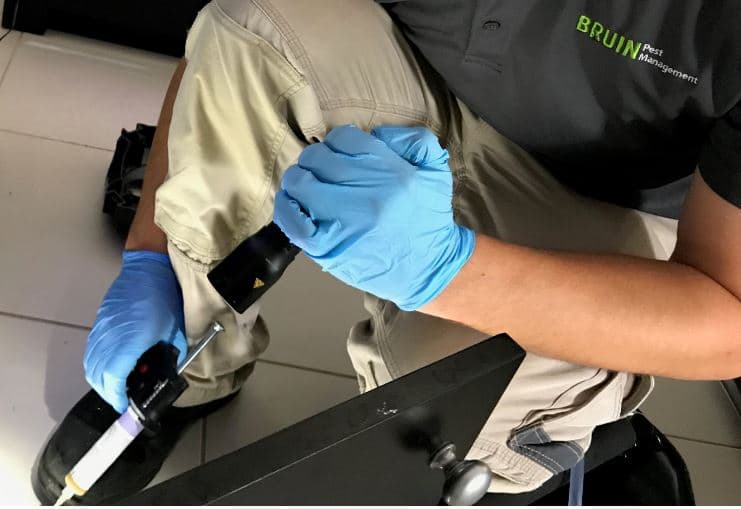
| Gel bait (cockroaches, ants) | Small dots in cracks, hinges and under sinks | Leave the dots in place and keep kids and pets away from them. Don't wipe them off. |
| Dust | Roof voids, wall voids, subfloor | Applied where people don't live. Keep the hatch closed and stay out of the void. |
| Rodent bait stations | Enclosed stations in the roof or around the outside | Leave the stations closed and in place. Tell the technician about pets and kids. |
| Termite soil treatment (treated zone) | Soil around and under the home | Keep kids and pets away from the work area during application and until the technician says it's clear. |
| Termite bait stations | In-ground stations around the home | Leave lids on. The technician checks them on scheduled visits. |
Notice that most of these aren't applied in the middle of your living room. Technicians choose the method to put the product where the pests are and away from where you are.
What should you do before and after treatment?
A little preparation makes the visit smoother and safer. Our guide on preparing your home for pest control goes into more detail. These are the basics.
- Move pet bowls, toys, and bedding out of the areas being treated.
- Put away food, dishes and kids' toys, or cover them.
- Cover or turn off fish tanks, and take birds to another room or out of the home.
- Leave when the technician asks you to, and take the kids and pets with you.
- Open windows to air the home when the technician says it's fine.
- Ask before you mop or vacuum treated areas, and keep the receipt and product details.
Wiping down skirting boards or mopping the perimeter too soon can remove the product before it's had a chance to work. So ask your technician how long to wait before you clean the treated areas.
Babies, kids and pregnancy
Tell us when you book if there's a baby, a toddler or someone pregnant in the home. It lets the technician pick the method and placement with that in mind, and plan the visit so you can be out while it's done.
Follow the label directions and your technician's advice. If you're pregnant or have a health concern, speak to your GP as well. If someone is unwell after a treatment, call the Poisons Information Centre on 13 11 26, and call 000 in an emergency. Have the product name from your treatment record handy. We're pest technicians, not doctors, so we don't give medical advice.
Pets, fish and birds
Cats and dogs like to sniff and lick new things, so keep them away from wet treated areas and away from bait and stations. Fish tanks need covering, with air pumps turned off while spraying is happening nearby. Birds are sensitive to fumes and are usually best kept well away from the area during treatment.
Our guide on whether pest control is safe for pets goes into more detail. Tell your technician what animals you've got, including reptiles and small animals. It changes the plan.
Will the bugs die straight away?
Not always. Pests pick up the product by walking over treated surfaces or eating bait, and that takes time. In the days after a treatment you may still see some, and sometimes a bit more activity as they come out of hiding.
Don't spray over the top with a supermarket product. It can interfere with the treatment. If you're still seeing plenty of pests after the period your technician mentioned, call us. That's what the free service period on our general treatments is for.
Sources and further reading
- Queensland Health (opens in a new tab)health.qld.gov.au
General information for South East Queensland conditions. Every property is different; a licensed inspection is the only way to know what is going on in yours.