
On this page · 5 sections
There's a grey, papery nest under the eave, in the letterbox or in the corner of the patio, and the kids play right there. Most paper wasps leave you alone if you leave them alone. The trouble starts when a nest is above a door or somebody gets stung. Here's how to decide.
How do you know it's a paper wasp nest?
Paper wasps (Polistes species) build a single, open comb of hexagonal cells, like an upside-down umbrella or shower head, hanging from a short stalk. The paper is grey or tan because the wasps chew wood fibre and plant material. You can see the cells and often the wasps sitting on top. Paper wasps are slim, with long dangling back legs in flight, and a yellow and brown or reddish body.
In Brisbane they like sheltered spots that stay warm and dry, such as under eaves, in the underside of pergolas and carports, inside letterboxes, behind shutters, in barbecue covers and in dense shrubs. Nests are small in early spring and grow through the warmer months.
Paper wasps or European wasps?
Most nests around Brisbane homes are paper wasps. European wasps (Vespula germanica) are a different insect. They're stockier and brighter yellow and black, and they usually nest in the ground or in wall cavities rather than hanging in the open. They're mostly a problem in the southern states, and they're uncommon in Queensland.
If you think you've found a European wasp nest, don't disturb it, and report it to Biosecurity Queensland. Other insects get mistaken for wasps too. Honey bees and native bees are useful pollinators, and native bees are protected, so call a beekeeper rather than a pest controller. Mud nests, made of small tubes or pots of mud, belong to mud dauber or potter wasps, which rarely sting.
| Insect | Nest | Where | What to do |
|---|---|---|---|
| Paper wasp | Open grey honeycomb, one stalk | Eaves, letterboxes, pergolas, shrubs | Keep away. Small nests only if you're careful, otherwise call a pro |
| European wasp | Enclosed papery nest, often in the ground or a wall | Ground, wall cavities, roof voids | Don't disturb it and report it to Biosecurity Queensland |
| Honey bee | Wax comb in a hollow or box | Hollows, wall cavities, hives | Call a beekeeper |
| Mud dauber or potter wasp | Mud tubes or small mud pots | Walls, sheds, under eaves | Usually leave alone or knock off when empty |
When is DIY a bad idea?
A sting from a paper wasp hurts, and they can sting more than once. A disturbed nest can bring a group out fast. You're also often working from a ladder, with one hand up and no way to step back quickly. A fall off a ladder can do more harm than the wasps.
- Anyone in the household, or a neighbour, has a known allergy to stings
- The nest is above head height, on a ladder job, or in a roof or wall gap
- The nest is bigger than your hand or has a lot of wasps on it
- It's above a door, a clothesline, a play area or the letterbox
- You're not sure what the insect is
- You've been stung before and reacted badly
If none of these apply and the nest is small and low, you might choose to have a go. Do it in the cool of the evening or early morning, when the wasps are less active, wear long sleeves, gloves, a hat and eye protection, keep an escape route clear, and follow the directions on any product you use. Never block the nest opening or knock it down while wasps are on it.
What to do about stings and allergic reactions
For a normal sting, wash the area, apply a cold pack for pain and swelling, and keep an eye on it. Pain and a red, swollen spot are common. See your GP or pharmacist if it gets worse or looks infected.
An allergic reaction is different, and it's an emergency. Signs of anaphylaxis include difficulty breathing, wheezing, swelling of the face, lips or tongue, dizziness, collapse, or hives spreading over the body. Call 000 straight away. If the person has been prescribed an adrenaline autoinjector, use it as their action plan says, and don't stand them up or make them walk. Healthdirect has clear first aid steps for stings and anaphylaxis.
What happens when you call Bruin
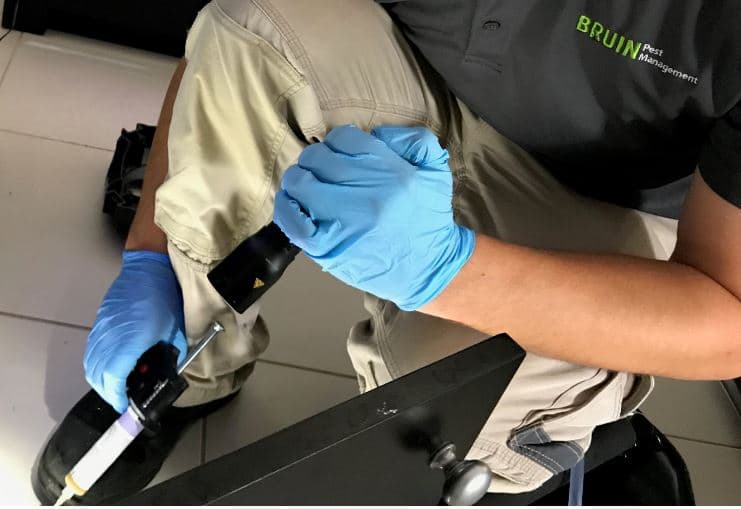
A licensed technician looks at the nest, works out the species and where it is, and treats it with a product suited to the site, following the label. We'll tell you how to keep people and pets away for a while afterwards. The nest can be removed once the wasps are gone, or left to fall off in time.
Wasp nests are often part of a bigger picture. If you've got one under the eave, check the other eaves, the pergola and the shed, and tell the technician what you find. Call us on 1300 349 177 or book online and we'll go through the price. If the nest isn't a paper wasp, we'll tell you plainly and point you to the right person, such as a beekeeper.
Sources and further reading
- Healthdirect Australia, stings and anaphylaxis (opens in a new tab)healthdirect.gov.au
- Queensland Health (opens in a new tab)health.qld.gov.au
General information for South East Queensland conditions. Every property is different; a licensed inspection is the only way to know what is going on in yours.